In my seven years working across buying offices and editorial styling suites, I have seen the “professional bag” evolve from a static staple into a point of intense sociological debate. I have spent countless hours in the trenches of retail, watching trends wax and wane, but the recent shift in boardroom aesthetics has been particularly fascinating. The question I receive most often from clients who travel for business—clients like myself who regularly log over 60 airport segments a year—is simple: "Are backpacks finally replacing the briefcase, or is the executive briefcase trend making a comeback?"
The answer lies not in a binary choice between convenience and formality, but in the intersection of structural integrity and the rise of "quiet luxury." If you are showing up to a high-stakes negotiation with a nylon backpack that flops over the moment you set it on the table, you are communicating something specific: that you are not prepared for the environment you are in.
The Backpack Fatigue: When Comfort Becomes a Liability
There was a period—roughly 2015 to 2021—where the tech-sector influence made the high-end backpack the ultimate symbol of the “innovator.” It suggested a person on the move, one who could pivot from a subway commute to a venture capital pitch without breaking a sweat. However, the pendulum is swinging back. In the most elite circles, the backpack is increasingly viewed as an artifact of a more casual, less structured era of business.
Boardroom norms are hardening. As we move away from the post-pandemic "casualization" of the workplace, the demand for visual gravitas has returned. When you walk into a room, your bag is part of your silhouette. A well-structured briefcase acts as an extension of a tailored jacket, providing a crisp line that a slouchy backpack simply cannot replicate. It signals that you are there to do serious work, not just commute to a remote office.

Quiet Luxury and the Death of the Branded Pull
One of the most refreshing shifts I’ve witnessed, heavily influenced by the sustainability conversations coming out of events like the Copenhagen Fashion Summit, is the move toward anonymous, high-quality design. My biggest pet peeve in the industry? Visible, ostentatious logos and—even worse—branded zipper pulls. Nothing screams “middle-management insecurity” like a giant logo plastered on a bag.
True luxury is about the materials and the assembly, not the marketing. When I am vetting a piece for a client, I look for "Quiet Luxury." This means clean lines, full-grain leathers, and hardware that functions perfectly without advertising its manufacturer to the entire room. If I see a logoed zipper pull, I immediately wonder where the brand cut corners elsewhere. It’s a repairable briefcase warranty telltale sign of a company prioritizing marketing over substance.
The Anatomy of Quality: What I Look For Before I Buy
When I am styling a client’s work wardrobe, I am essentially a technician. Before I even care about the color, I am looking at the stitching and the zipper brand. If a bag does not have a YKK zipper, I lose interest immediately. Why? Because YKK is the only manufacturer that consistently balances tensile strength with a smooth glide. Cheap zippers are the first point of failure in any bag; they snag, they split, and they feel flimsy. If a manufacturer is willing to cheap out on the most used component of the bag, they are absolutely hiding subpar tanning processes in the leather.
The A4 Sheet Test
Want to know something interesting? i carry an a4 sheet of paper with me whenever i am evaluating bags for clients. It is my litmus test for structure. A truly professional bag should hold its shape when empty. Exactly.. I place the A4 sheet inside the main compartment; if the bag slumps or tips over, it fails. A bag that cannot stand on its own is a bag that will eventually crush your documents and lose its aesthetic appeal within six months. Professionalism is about structure—your bag should mirror that.
The Leather Truth
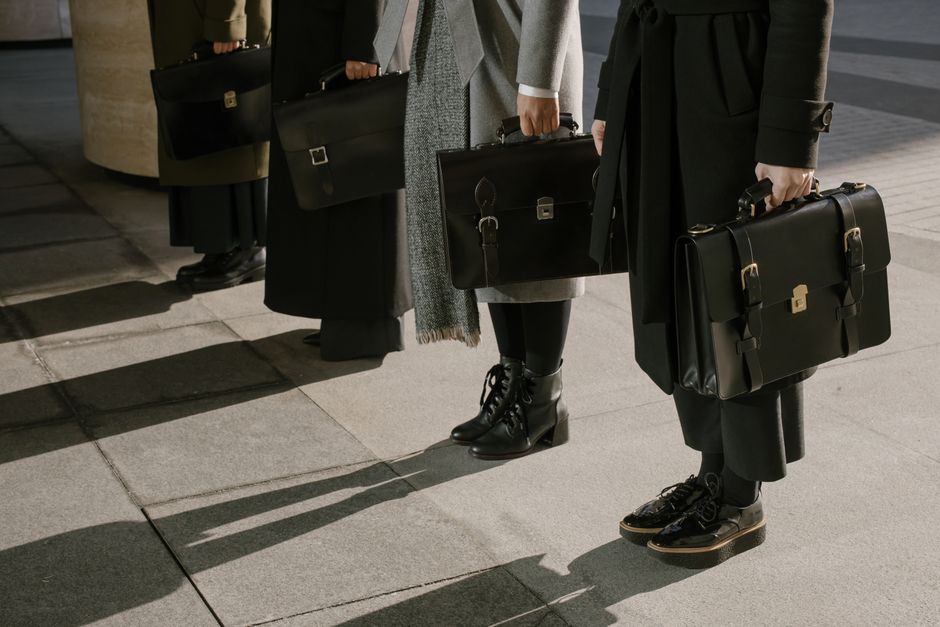
If you see a product description that simply says “genuine leather,” run. In the leather industry, "genuine leather" is not a mark of quality—it is the lowest grade of leather, usually composed of the leftover scraps of the hide that have been glued together and embossed with a grain pattern. It is the definition of "replace-only warranty" bait. A reputable brand, like Von Baer, will be explicit about their tanning process—usually vegetable-tanned, full-grain hide. You want leather that will develop a patina over time, not leather that will crack after two seasons of heavy use.
The Price-to-Performance Reality
I am often asked why I insist on recommending pieces that seem expensive. The reality is simple: the “mid-range” market is a wasteland of disposability. In my experience, briefcases priced under £200 almost inevitably fail within 18 months. The stitching will unravel at the stress points where the handles meet the body, and the "leather" will begin to peel. When you buy cheap, you are effectively paying for a subscription to a cycle of replacing your bag every year and a half. It is a false economy.
Feature The "Budget" Fail (Under £200) The Executive Standard Leather Grade Genuine/Bonded (Peels) Full-Grain Vegetable Tanned (Patina) Zippers Generic/Branded Logo Pulls YKK Excella or equivalent (Heavy duty) Structure Slumps/Collapses Structured/Self-standing Hardware Coated Plastic/Zinc Alloy Solid Brass or Stainless Steel Warranty Replace-only (often voided) Repair-focused/LifetimeProfessional Restraint: Proportion and Practicality
Proportion is the final piece of the puzzle. An executive briefcase should not look like a suitcase, nor should it look like a slim portfolio that can barely hold a laptop. It needs to be proportional to your frame. If you are 6'2", a tiny, ultra-slim document case will look comical. If you are 5'7", a massive, multi-gusseted lawyer’s bag will overwhelm your silhouette.
Consider the travel aspect. As someone who spends a significant portion of my life at 30,000 feet, I prioritize a bag that fits under an airplane seat without compromising its structure. You want a pass-through strap for your luggage handle, but it must be integrated seamlessly. A bulky, external nylon strap ruins the aesthetic. Look for internal sleeves or hidden pockets that allow for modern tech storage without turning your bag into a cluttered mess.
The Verdict: Is the Briefcase Back?
The briefcase never actually left; it just went through a period of being overshadowed by the "convenience culture" of the tech boom. Today, the executive briefcase is the uniform of the intentional professional. It says that you have curated your life and your image. It says you value longevity, sustainability, and quality over the disposable, logo-driven trends that define the mass market.
If you are looking to elevate your boardroom presence, stop looking for a "new" bag and start looking for a "last" bag. Invest in pieces where the zipper glide is buttery, the leather is thick enough to stand on its own, and the branding is non-existent. In a room full of people carrying slumping, logoed backpacks, the person carrying a perfectly structured, quiet leather briefcase is the only one who looks like they already own the room.
My advice? Check the stitching. Demand full-grain. Ignore the labels. If the bag can’t hold an A4 sheet without looking exhausted, leave it on the shelf. Your reputation deserves better.