Can your kid sit up and hold their head steady for the whole ride? If you cannot answer that with a definitive "yes," stop right there. Don't look at seat brands, don't look at rack hardware, and definitely don't look at your sleek carbon fiber frame yet. As someone who spent nine years in a bike shop service department, I have seen too many parents try to force a child onto a bike that just wasn't designed for it, or worse, put a child on a bike before their neck muscles were ready to handle the vibration of a pothole.
I’ve spent nearly a decade fitting child seats to everything from high-end carbon road machines to rusty commuters, and I keep a tiny notebook in my back pocket specifically for "things that rattled loose mid-ride." If you’re planning to attach a road bike child seat to your weekend warrior, you need to understand the physics of what you are doing. Road bikes are designed for speed, low weight, and agility. Child seats are designed for stability, weight distribution, and safety. These two concepts often hate each other.
Beyond Age: Assessing Developmental Readiness
I get emails every day asking, "Is my 9-month-old ready?" or "My kid is one, can we start?" I hate these questions. "Age" is a useless metric for cycling safety. I need to see physical markers. Instead of waiting for a calendar date, look for these specific signs:
- Neck Control: Can your child hold their head upright while wearing a helmet? A helmet adds roughly 8–12 ounces of weight to their head. If they can’t support that extra load while you hit a ripple in the pavement, they aren't ready. Core Stability: Can they sit unsupported for at least 15 minutes? If they slump or tip when they get tired, they will slump in the seat, which creates a dangerous center-of-gravity shift for the rider. Vibration Tolerance: Do they have the muscle tone to stabilize their spine against low-frequency vibration? Road bikes transmit more road noise and shock to the seat than fat-tire hybrids or mountain bikes.
If your child is still struggling to maintain a neutral spine, stick to a stroller for a few more months. It’s not worth the risk.
The Road Bike Reality Check: Frames and Hardware
The biggest challenge when installing a road bike child seat is the frame geometry. Most modern road bikes are designed with narrow clearances and performance-oriented materials. Here is where the "rattling" begins.
Rack Mounts on Road Bikes
Does your frame have integrated eyelets on the seat stays or near the rear dropouts? If you are riding a pure racing frame, the answer is likely no. Trying to mount a seat that requires rack mounts road bike hardware on a frame that doesn't have them is a recipe for disaster. Never use "P-clips" or hose clamps to attach a heavy-duty seat to a carbon frame. The frame tubing isn't designed to handle point-loading pressure, and you will crush your seat stays.
Seat Type Compatibility with Road Bikes Pros Cons Front-Mounted (Center) High (if stems allow) Better balance, you can see the kid. Limits your pedaling room (knee clearance). Rear-Mounted (Rack) Medium (Requires mounts) Sturdier, better for longer rides. Needs specific rack compatibility. Trailer High (Uses axle mount) Lowest center of gravity. Changes handling drastically; heavy.Handling Narrow Tires and Weight Distribution
Let’s talk about handling narrow tires. Road bikes typically run 25mm to 28mm tires at high pressure. This combination is inherently "twitchy." When you mount a child seat—especially a rear-mounted one—you are moving the center of gravity up and back. This changes the handling characteristics of your bike instantly.
The Braking Shift: Your front brake does 70% of your stopping. With a child on the back, that ratio changes. You need to practice emergency stops in a parking lot. The "Wobble" Effect: Narrow tires offer less contact patch. If your child leans to one side, the bike will track that lean much faster than a mountain bike would. You have to be an active rider, not a passive one. Pedal Strike: If you use a front-mounted seat, you will likely develop "cowboy knees"—pedaling with your knees bowed out to avoid hitting the seat. This changes your biomechanics and can lead to knee pain over long distances.The Helmet Fit: Non-Negotiables
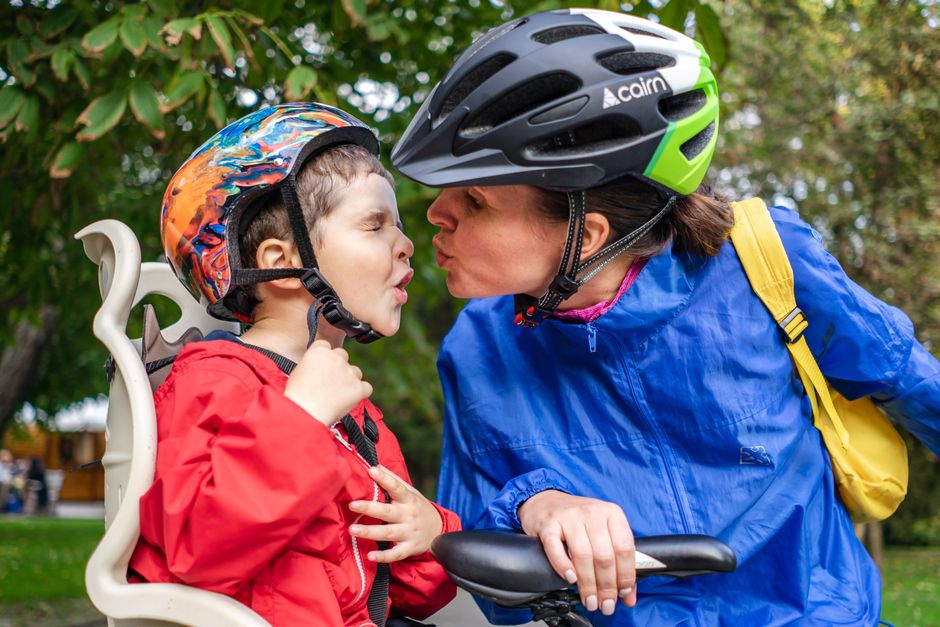
If I see one more child with a helmet tilted back, exposing their forehead, I am going to lose my mind. Your helmet fit check should be a ritual. Every. Single. Time.
The "Two-Finger" Rule
When performing your bike helmet fit checks, follow this sequence:
- The Two-Finger Rule: The front of the helmet should be two fingers width above the eyebrows. If it's higher, it's useless. The "V" Shape: The straps should form a perfect 'V' just under the ears. If the slider is dangling halfway down the neck, the helmet will slide off in a crash. The "One-Finger" Gap: You should be able to fit only one finger between the chin strap and the child's chin. Any more, and the helmet can be whipped off during a fall.
The Test Ride: Don't Skip It!
I cannot stress this enough: Parents who skip the test ride without the child are setting themselves up for a roadside disaster. Before you go on your first real commute or scenic ride, do a 10-minute loop in a quiet, flat area. Listen for the rattles. In my notebook, I track the most common offenders: loose seat stay bolts, poorly tightened quick-release levers, and clicking buckles. If you hear a rattle, stop. Re-torque the bolts to the manufacturer’s specifications. If you don't have a torque wrench, get one. Do not guess with children's safety.
Final Verdict: Can it be done?
Yes, you can use a child seat on a road bike, but you must be honest about your setup. If your road bike lacks rack mounts, don't force a rear-mount seat onto it. Look for frame-mounted front seats that use specialized adapters, or consider an axle-mounted trailer if your frame material is too fragile for seat hardware.
Remember: your goal is the safety of your passenger, not your Strava segment time. If the seat blocks your natural pedaling motion, forcing your knees to hit the plastic, it is not a safe setup. If the handling feels twitchy and uncertain, your child will feel that lack of confidence. Keep the rides short, keep the gear tightened, and for heaven's sake, keep that helmet level.
If you aren't sure, go to your local bike shop. Bring your bike. Bring your kid. Ask the lead mechanic to check the hardware interface. We might be grumpy about the noise, but we are always, always happy to help make sure the gear is solid.